From 2017 to 2021, I had the privilege of serving as a Microsoft Azure MVP. My work evolved alongside the industry itself:
- 2017 to 2019: IoT, distributed systems, device identity, event-driven architectures
- 2019 to 2022: Machine Learning, pipelines, MLOps, operational rigor
- 2022 to Today: NLP and Agentic AI, language models, orchestration, autonomous workflows
Along the way, I also developed extensive experience with BERT models for semantic search, similarity scoring, and embedding-based retrieval. That work became foundational to my thinking about, knowledge representation, content modeling, and the semantic layers required for intelligent systems.
Each phase built the foundation for the next. IoT taught me how systems communicate. ML taught me how systems learn. Semantic search taught me how systems understand. NLP taught me how systems reason. All of that now converges into the next major shift.
Agentic AI is redefining how systems are designed, and Azure is at the beginning of that journey.
Over the past 3 years, I have been deep in LangChain, LangGraph, and the broader open source agentic ecosystem. I have built real multi-agent systems, production workflows, and event-driven pipelines that go far beyond the simple pattern of “call a model, get a response.”
And I have noticed something important:
- Open source frameworks have sprinted ahead in developer adoption
- Microsoft is just beginning to release agentic tooling and getting adoption.
- Enterprises, especially government and regulated industries, want agentic systems that are secure, auditable, and operationally reliable
- Most organizations still lack the knowledge graph, ontology, taxonomy, and property-rich content models required for agents to reason effectively, stay grounded, and produce citations.
This is the gap I am stepping into.
Agentic AI Is Not a Feature; it is an Architectural Shift
Most people still treat AI as a single model call. Agentic AI breaks that paradigm.
An agent is not a prompt. It is not a chat interface. It is not a wrapper around an LLM.
An agent is a system, and often a system of systems:
- State
- Context
- Memory
- Tools
- Goals
- Autonomy
- Event-driven behavior
- Orchestration logic
- Observability and governance
This is architecture, not syntax, and architecture is where Azure has always had the potential to shine.
The Missing Ingredient: Knowledge Graphs, Ontologies, and Taxonomies
Here is a truth the industry is only beginning to acknowledge: agentic AI is only as good as the knowledge structures it can reason over.
Most enterprises lack:
- A well-defined taxonomy
- Clean, governed metadata
- A consistent ontology
- A coherent knowledge graph
Organizations often rely on unstructured or semi-structured content, which, when used for agents, causes them to hallucinate, misinterpret context, and fail to execute reliably.
Clients need significant help here, not because they are behind, but because the industry never required this level of semantic rigor until now.
Agentic AI changes that.
If you want agents that make decisions, take actions, follow policies, execute workflows, maintain context, and produce consistent outcomes, then you need structured knowledge.
This is where Azure has an opportunity to lead, but only if we bring the right architectural patterns to the table.
The Hard Part: Balancing Deterministic Logic with Stochastic Intelligence
Agentic orchestration is not simply “let the model decide.”
Real systems require a careful balance between:
- Deterministic business processes, compliance rules, policy enforcement, workflow steps, required approvals, and auditability
and - Stochastic generative AI, reasoning, interpretation, summarization, planning, and tool selection
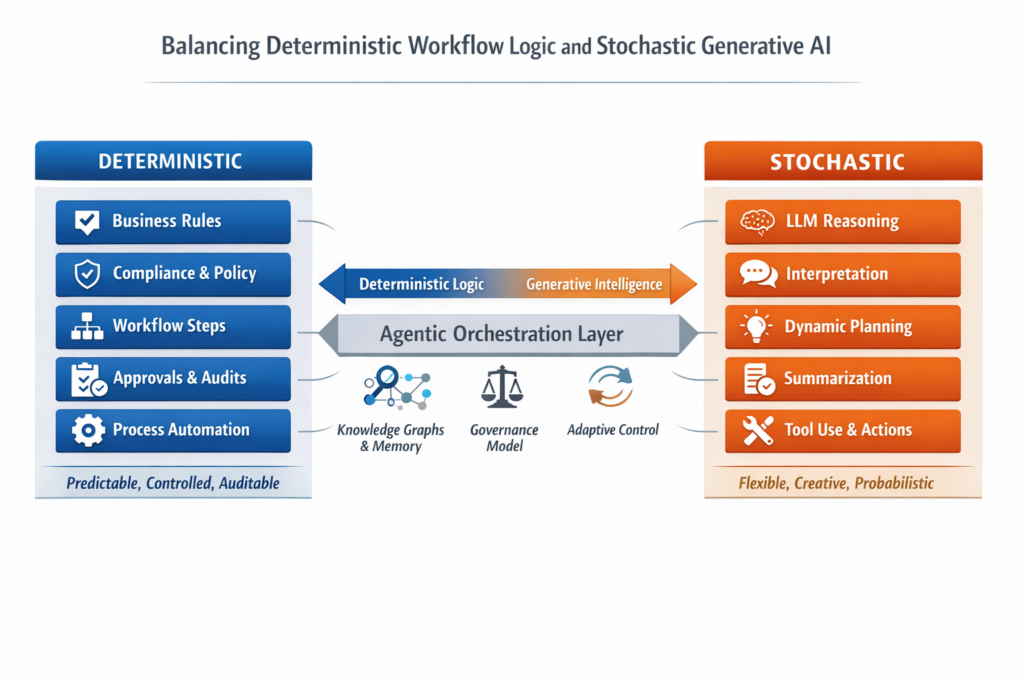
Too much determinism, and your agent becomes a glorified workflow engine.
Too much stochastic behavior, and your agent becomes unpredictable and ungovernable.
The solution is a governance model that is defined, adopted, enforced, observed, iterated, and refined.
This is the next frontier of enterprise AI architecture, and it is where Azure’s event-driven, identity-driven, and policy-driven ecosystem can shine.
Microsoft Is Early, and That Is the Opportunity
Azure AI and the early agentic patterns coming out of Microsoft are promising, but they are still in their infancy. Developers and enterprises are asking for:
- Durable, event-driven agent workflows
- Multi-agent orchestration
- Integration with Azure Functions, Event Grid, and Managed Identity
- Real observability
- Real governance
- Real production readiness
- Semantic foundations, knowledge graphs, ontologies, taxonomies
- Embedding strategies that integrate with structured knowledge, not replace it
Meanwhile, open source, especially LangGraph, already provides:
- State machines
- Checkpointing
- Tool routing
- Multi-agent orchestration
- Human-in-the-loop hooks
- Retry and recovery logic
But enterprises want these patterns inside Azure, not bolted on top.
This is the gap I am stepping into.
My Mission for AzureSteve.com, 2026 and Beyond
I am returning to this blog with a clear purpose:
1. Bring agentic architecture to the Azure ecosystem
Real patterns, real diagrams, real production guidance.
2. Translate open source innovation into Azure-native patterns
LangGraph to Durable Functions
LangChain tools to Azure Functions with Managed Identity
Multi-agent orchestration to Event Grid and orchestration patterns
Memory to Cosmos DB, Tables, and Vector Search
3. Provide an honest, technical analysis of Microsoft’s agentic tooling
Constructive, detailed, and grounded in real engineering.
4. Bridge the gap between open source and Azure
Open source has the momentum, Azure has the enterprise trust; developers need both.
5. Lead the conversation on semantic foundations
Knowledge graphs, ontologies, taxonomies, and embedding strategies such as SBERT that support semantic reasoning.
6. Define governance models for agentic systems
Deterministic logic and stochastic reasoning, policy and autonomy, control and creativity.
7. Support regulated industries
Government cloud, compliance, auditability, this is where I have lived for years.
What Is Coming Next
Over the next several weeks, I will publish posts on:
- The real architecture behind agentic systems
- Running LangGraph agents natively on Azure
- Building semantic foundations for agentic AI
- Governance models for deterministic and stochastic orchestration
- Multi-agent orchestration using Azure primitives
- Event-driven agents with Functions and Event Grid
- Audit-ready agentic workflows for government and regulated industries
- A roadmap for how Azure can win the agentic AI platform race
This is not a theory. This is engineering.